Naxqelvi
Align Collection
Align Collection
Couldn't load pickup availability
- Problem Statement
As editing projects grow, learners may find that every part of the timeline needs attention at the same time. Scene order, pacing, frame balance, motion direction, light mood, text placement, transitions, and revision notes can all affect how the project feels. A timeline may contain strong individual sections, but the full piece can still feel uneven when those sections do not share a clear direction. Learners may also struggle to decide what to adjust first when several parts feel unfinished or disconnected. Align Collection was created to help learners study the full editing workflow as one connected structure.
- Solution
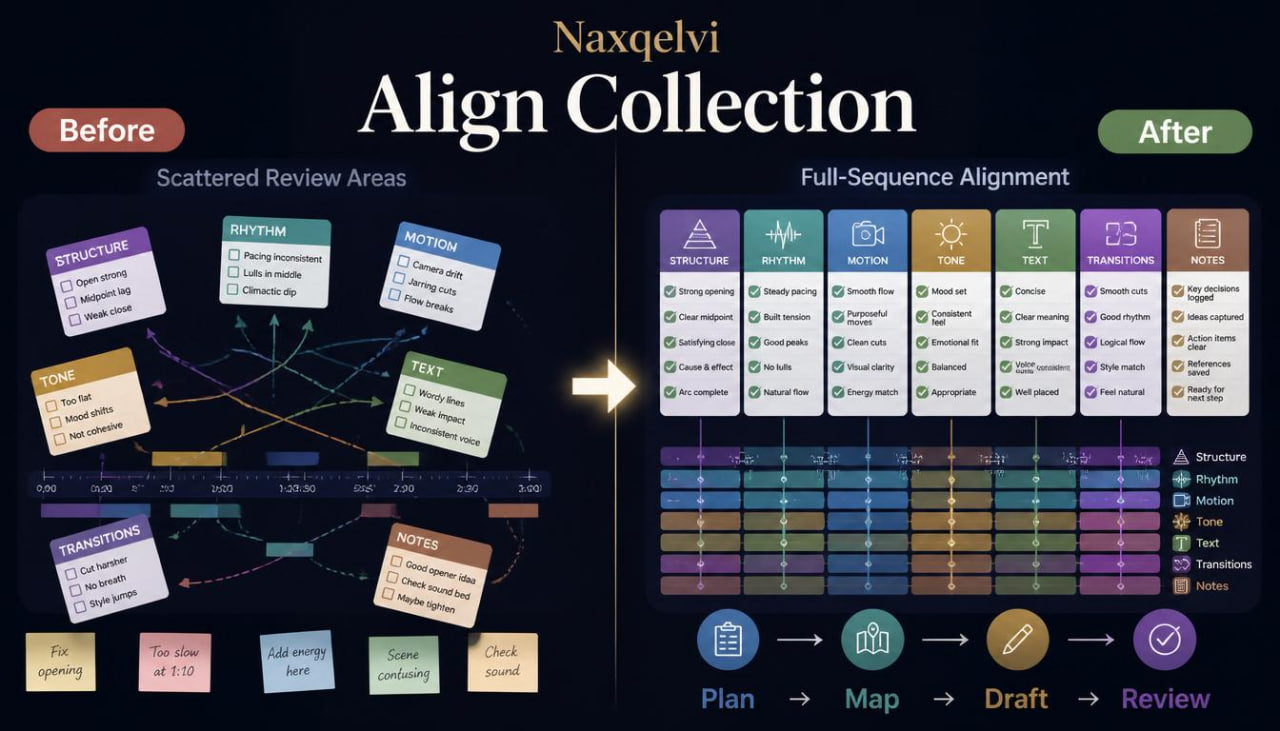
Align Collection gives learners a broad set of Naxqelvi materials for aligning different editing choices inside one project. The course explains how to plan a timeline, map rhythm, review frames, connect motion, check visual tone, organize text elements, and write revision notes through one structured process. Learners are guided to examine the full project from several angles without losing the main direction. The tier includes planning maps, alignment worksheets, revision tables, full-sequence checklists, and guided practice tasks. Align Collection supports thoughtful editing study by helping learners connect smaller choices with the shape of the whole timeline.
- What’s Inside
Align Collection includes the widest Naxqelvi study materials in the course path, built around full-project alignment. The tier begins with an orientation module that explains how different editing choices can work together. Learners study how a project can feel more organized when structure, rhythm, motion, visuals, transitions, and notes are reviewed as connected parts rather than separate tasks.
The first main section focuses on full timeline planning. Learners study how to outline the beginning, middle, and ending before arranging detailed clips. This section explains how to define a project idea, choose the first visual impression, note the main rhythm, and describe the intended closing tone. The goal is to create a planning base that can guide later editing choices.
The second section explores structure alignment. Learners review how every section of the project connects to the next. The materials explain how an opening can introduce a visual idea, how the middle can develop it, and how the ending can return to it or settle it. This section includes written examples where a project feels disconnected because its sections do not share a clear relationship.
The third section focuses on rhythm alignment. Learners study how pacing changes should relate to the project’s structure. A calm section, active section, pause, or rhythm shift can each have a role in the timeline. The materials guide learners to mark rhythm changes before editing and review whether those changes support the full sequence.
The fourth section introduces motion alignment. Learners examine movement direction, movement speed, subject action, stillness, and motion bridges. This part explains how movement can connect different sections or create planned contrast. Learners are encouraged to map movement across the project instead of reviewing each clip alone.
The fifth section covers visual alignment. Learners study how light mood, contrast, color direction, frame balance, subject placement, and background detail shape the full project. This section helps learners check whether the visual tone changes with intention or distracts from the sequence. It also explains how visual patterns can create continuity across separate scenes.
The sixth section focuses on text and graphic placement in editing projects. Learners study how written elements can be placed with timing, spacing, and visual balance in mind. The course explains how text can support clarity when it fits the rhythm and frame structure. Learners review placement, screen space, reading time, and relation to the surrounding visuals.
The seventh section introduces transition alignment. Transitions are reviewed through project role, not decoration. Learners study whether a transition marks time, location, mood, subject change, section movement, or visual echo. This helps learners decide when a direct cut may be enough and when a transition has a clear reason.
Align Collection includes a full-project alignment worksheet. This worksheet has areas for project idea, scene order, rhythm pattern, movement map, visual tone, text notes, transition reasons, and revision comments. It gives learners one place to organize the main editing decisions before and after a draft.
A revision table is also included. This table separates review into structure, rhythm, motion, visual tone, text elements, transitions, and final notes. Learners can use the table to review one area at a time and avoid making scattered changes without direction.
The tier includes a guided full-sequence task. Learners create a project outline, prepare an alignment map, arrange a first draft, review it through several passes, and write notes for a second version. The task encourages observation and adjustment rather than a fixed result.
Align Collection also includes a continuity checklist. This checklist asks learners to review whether the opening relates to the ending, whether rhythm changes feel planned, whether movement supports scene flow, whether visual tone remains connected, whether text elements have enough space, and whether transitions have a clear role.
A glossary is included with terms related to full-project alignment. It explains structure alignment, rhythm alignment, motion map, visual continuity, scene relationship, transition role, revision table, alignment worksheet, full-sequence review, and project direction. Each term is written in clear language for study use.
The final section is a project reflection log. Learners write down which areas felt organized, which areas needed review, which revision pass gave helpful notes, and what they would adjust in another version. This log helps learners build a written record of their editing decisions and study observations.
- Who Is This For?
Align Collection is for learners who want the broadest Naxqelvi course tier in this collection. It is suitable for people who have studied earlier topics such as timeline order, frame flow, visual tone, motion, calm pacing, layered review, and pattern-based editing.
This tier may be useful for learners who want to work with larger practice projects and need a structured way to review many editing choices. It is also suited for learners who prefer written modules, planning maps, worksheets, review tables, and guided project tasks.
Align Collection is intended for learners who want to connect editing decisions into one organized workflow. The focus is on study, planning, observation, and revision. It does not rely on pressure wording or outcome claims.
- What You’ll Learn
- How to plan a full editing project before arranging detailed clips
- How to connect the opening, middle, and ending of a timeline
- How to review project structure across several sections
- How to map rhythm changes before editing
- How to align pacing with project direction
- How to review movement direction across a full sequence
- How to use motion bridges between scenes
- How to check visual tone across multiple clips
- How to review light mood, contrast, color direction, and frame balance
- How to place text elements with timing and screen space in mind
- How to decide whether a transition has a clear role
- How to use a full-project alignment worksheet
- How to review a draft through separate revision passes
- How to compare first and second versions of a project
- How to write project reflection notes for later study
- How to connect smaller editing choices with full-sequence structure
- 30-Day Refund Terms
Align Collection includes a 30-day refund request period according to the Naxqelvi store policy. Customers may submit a refund request within 30 days of purchase when the request follows the stated order conditions and refund rules.
Self-paced learning overview
- 📁 Digital file available after purchase
- 📚 Long-term availability
- 🔒 Secure checkout
- 🗓️ Content updated in 2026
What format are the Naxqelvi course materials provided in?
What format are the Naxqelvi course materials provided in?
Naxqelvi course materials are prepared as digital learning resources for self-paced study. They may include written modules, editing notes, planning tables, recap sections, practice tasks, and project-based examples.
Can I study the materials at my own pace?
Can I study the materials at my own pace?
Yes. The materials are created for gradual study, so learners can read, review, pause, return to earlier topics, and repeat practical tasks when needed.
Do I need previous editing knowledge before starting?
Do I need previous editing knowledge before starting?
No previous editing background is required for the starting tiers. The first materials introduce core ideas such as timeline order, scene rhythm, visual flow, transitions, and basic project organization.
Share